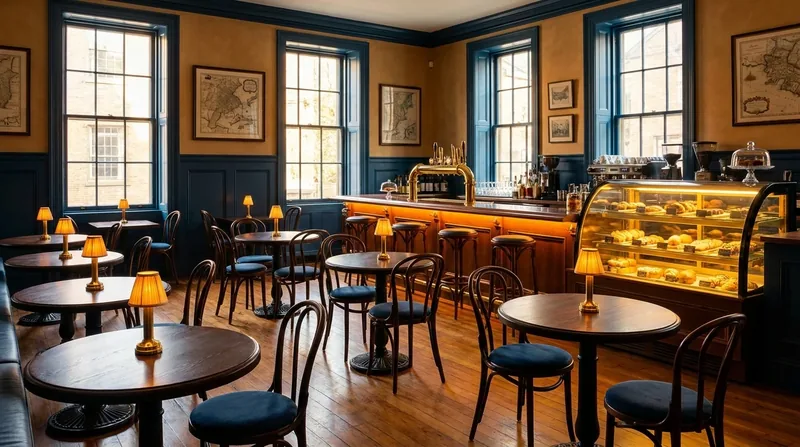
How to Start a Coffee Shop in Virginia: VDH Permit $40 Plus $40, CFPM and $450 Wine and Beer License
Opening a coffee shop in Virginia depends on getting three things right in the right order. The first is the Virginia Department of Health (VDH) food permit, which starts with a plan review before you build or remodel. That review costs $40, and the permit itself costs another $40. The second is a Certified Food Protection Manager (CFPM) on staff. The third is a wine and beer license from the Virginia Alcoholic Beverage Control Authority (ABC), if you plan to serve beer or wine. That license carries a $450 state fee per year. This guide follows the order you should do things in, because the most expensive mistakes first-time owners make come from building before the plans are approved or signing a lease before checking zoning.
This is informational content, not legal or tax advice. Confirm every step with the agency named in it before you spend money.
What You Need Before You Start
Most of the paperwork is built from a short list of documents and decisions. Gather these early, because the health department and the State Corporation Commission (SCC) will ask for them.
- A scaled floor plan showing plumbing, lights and fixed equipment
- An equipment list with manufacturer specification sheets for each piece of equipment
- Your proposed menu, including pastries, syrups, sauces and any other items with allergens
- CFPM credentials for the employee who will hold supervisory authority
- Your entity formation documents (Articles of Organization or Articles of Incorporation) and a federal Employer Identification Number (EIN) from the IRS
- A signed lease or written property owner approval for the space
- A decision on whether you will serve beer or wine, roast beans, sell packaged bags, or run a drive-through
Some of these decisions change which approvals you need. Alcohol means an ABC license. A drive-through and signs need local approval. Roasting coffee for sale brings in the Virginia Department of Agriculture and Consumer Services (VDACS), so check with VDACS before you roast anything for sale.
Step 1: Pick Your Concept and Confirm the Scope
Write down what you plan to sell and how. An espresso bar with drip coffee and grab-and-go pastries has a different permit footprint than a café with seating, a full kitchen, and beer and wine service. Decide now whether you want seating, whether you will bake on site, and whether you want to sell whole bean bags. Each answer affects your plan review, your sales tax questions and your local approvals.
If you think you might add alcohol later, plan the layout for it now. Changing a floor plan after plan review means another review.
Step 2: Form Your Entity and Reserve Your Name
Most coffee shop owners form a Virginia limited liability company (LLC). The Articles of Organization (Form LLC1011) cost $100 and are filed through the SCC Clerk's Information System at https://cis.scc.virginia.gov/. If you need speed, online filings can be expedited. Next-day service costs $50 or $100 if submitted by 2:00 PM Eastern, with a response by 4:00 PM the next business day. Same-day service costs $200 if submitted by 10:00 AM Eastern, with a response by 4:00 PM. Expedited service is online only and nonrefundable.
The name must include a required ending such as "LLC", "L.L.C.", "limited liability company" or "LC", and it must be distinguishable from names already on file. You can reserve a name for $10 for 120 days through the SCC at https://www.scc.virginia.gov/businesses/.
If you form a corporation instead, the Articles of Incorporation (Form SCC619) cost $75. A corporation also files an annual report and pays an annual registration fee based on authorized shares: $100 for up to 5,000 authorized shares plus $30 for each additional 5,000 shares. Check the SCC annual fee schedule for current figures.
Every Virginia entity must keep a registered agent with a Virginia street address where it can be reached during business hours. The agent must be a Virginia resident and either a Virginia State Bar member or a member, manager, officer, trustee or general partner of the entity. The entity cannot serve as its own agent.
If you will operate under a trade name instead of your legal name, file an Assumed Name Certificate with the SCC for $10. It is not filed with the circuit court, and there is no newspaper publication requirement.
An LLC files no annual report in Virginia. It pays a $50 annual registration fee to the SCC. That fee is due the last day of the 12th month after the month the LLC was organized, and every year after. The SCC assesses it about two months ahead. A late payment adds a $25 penalty, and the LLC is canceled at the end of the third month after the due date.
Step 3: Confirm Zoning and Local Approvals
Before you sign a lease, confirm with the locality that a food service use is allowed at the address. Then ask about the certificate of occupancy, the fire inspection, and any drive-through or sign approvals. These are all local decisions, and they can take longer than the state steps.
Virginia has no general statewide business license, and the SCC issues none. The local business license is the Business, Professional and Occupational License (BPOL) tax under Va. Code 58.1-3700 et seq. It is administered by each city or county, usually through the Commissioner of the Revenue.
Do not assume your locality charges BPOL. Virginia law lets a locality levy no general license (Va. Code 58.1-3704), and some do not. Stafford, Rockingham, Bedford County, Washington County, Montgomery County, Louisa and Fluvanna are examples of localities without a general county license. Towns can also displace the county tax within their limits. Population affects the minimum. A locality over 50,000 people cannot require a license for gross receipts under $100,000. A locality of 25,000 to 50,000 people cannot require one for gross receipts under $50,000. There is no floor for a locality under 25,000 people. Localities over 50,000 may waive the license up to $200,000 in gross receipts, but verify the waiver ceiling with your locality.
Localities set their own rates and filing deadlines. Ask the Commissioner of the Revenue which BPOL category a coffee shop falls under in your locality, because retail and restaurant categories are often treated differently. The meals tax is also local. Counties may levy a meals tax of up to 6 percent (Va. Code 58.1-3833), and cities set their own rates.
Step 4: Submit the VDH Plan Review Before You Build
This is the step most often done too late. A coffee shop is a food establishment, and you must submit a plan review application with a $40 fee to your local health department before you build out or remodel. Do not start construction until the plans are approved.
Your plan review package should include scaled floor plans showing plumbing, lights and fixed equipment, an equipment list with manufacturer specification sheets, your proposed menu, and your CFPM credentials. Expect the reviewer to focus on the three-compartment sink and the separate handwashing sink. Those are typical plan review items, and getting them wrong means rework.
Some health districts use their own forms or ask for more detail than the list above. Call your local health department early, ask which forms they require, and ask whether they want to meet before you finalize drawings. A short call at the start can save weeks.
Step 5: Assign a Certified Food Protection Manager
Virginia requires at least one employee with supervisory authority at each food establishment to be a Certified Food Protection Manager. The certification must come from an ANSI-accredited program recognized by the Conference for Food Protection. Your establishment may qualify for an exemption under 12VAC5-421-55 B or Va. Code 35.1-25, so confirm that with the health department before you assume you are exempt.
Virginia does not have a statewide food handler card. Do not plan around a $15 cap or a 30-day rule that you may have seen elsewhere. Those rules belong to other states. For any other employee training the health department expects, check with your local health district. Exam prices vary by provider, so get the current price from the program you choose.
Step 6: Understand the New Food Regulations
Updated Virginia Food Regulations took effect September 10, 2026, and they affect coffee shops directly. Three changes matter most:
- Written allergen disclosure. You must provide written disclosure of the nine major food allergens for packaged and unpackaged foods. Those nine are milk, eggs, fish, crustacean shellfish, tree nuts, peanuts, wheat, soybeans and sesame. Pastries, syrups, sauces and flavored drinks all need review.
- Hot water temperature. Minimum hot water temperature is 85 degrees F. Confirm your water heater can meet it at every sink you plan to use.
- On-site person in charge. A low-risk facility may operate without an on-site person in charge, but only with local health department approval.
VDH is drafting further allergy notice rules, so check VDH for 2027 changes before you finalize your menu signage.
Step 7: Build Out and Install Equipment
Build according to the approved plans. If you deviate from the plans, call the health department before the work is done. Install the three-compartment sink, the handwashing sink, refrigeration, and any dishwashing equipment exactly as the plans show, and keep the manufacturer specification sheets on file.
Equipment, rent and build-out costs vary widely from one space and one concept to another. Get written quotes from several vendors and contractors, and compare them against the approved plan rather than against a rule of thumb.
Step 8: Apply for the Foodservice Permit and Schedule Inspection
After plan approval and once the space is built, submit the foodservice permit application with a $40 fee. Submit it at least 30 days before you plan to open. In the same process, request the pre-opening inspection. The permit is issued when the space is finished and passes inspection, not when you submit the paperwork.
If ownership of the business changes after the permit is issued, you need a new application. Do not assume the existing permit transfers with the business.
Step 9: Decide on Wine and Beer (Optional)
If you plan to serve beer or wine, the usual route is the ABC on-and-off premises wine and beer license. Do not apply for a limited mixed beverage license for beer and wine. That is a different license for a different purpose. The wine and beer license has two costs:
- A state fee of $450 per year (Va. Code 4.1-231.1)
- A local license tax under Va. Code 4.1-233.1, capped at $150 in a city or $37.50 in a county or town
The local amounts above are maximums. Your actual local fee may be lower, so check with your locality. Ask ABC about the application fee and current processing time, because those figures are set by ABC and can change. Plan your opening date around ABC's timeline and do not promise customers beer or wine until the license is issued.
Spirits are a different scale of commitment. Serving spirits requires a mixed beverage license. A mixed beverage restaurant license has state fees starting at $1,050 for up to 100 seats, and a limited mixed beverage license has state fees starting at $945. Both come with food sales ratio rules. If you are considering spirits, treat it as a separate project with its own planning.
Step 10: Register for Sales Tax
Prepared drinks and food sold for immediate consumption are taxable sales in Virginia. Register through Virginia Tax at https://www.tax.virginia.gov/sales-and-use-tax before you start selling. The state base rate is 5.3 percent, which combines state and local tax. Your location may carry a higher combined rate: 6 percent in the regional-tax localities, 6.3 percent in eight localities, and 7 percent in the Historic Triangle of James City County, Williamsburg and York County. Confirm the combined rate for your address.
Do not assume packaged whole bean coffee qualifies for the reduced grocery rate of 1 percent. Ask Virginia Tax how packaged beans are classified before you set your retail prices.
Step 11: Hire, Pay and Insure Your Staff
Workers' compensation insurance is required once you have three or more employees (Va. Code 65.2-101). If you do not carry it, the penalty can be up to $250 per day, capped at $50,000 (Va. Code 65.2-805). Get coverage in place before your first shift.
Virginia's state minimum wage is $12.77 in 2026, $13.75 in 2027 and $15.00 in 2028. Build your labor budget around those figures, and confirm any local wage rules with your locality.
Tips and Common Mistakes to Avoid
- Building before plan approval. This is the most expensive error. Get the $40 plan review approved first.
- Treating the $40 permit as the whole VDH cost. The total VDH fee is $80: $40 for plan review plus $40 for the permit.
- Signing a lease before checking zoning and BPOL. Confirm the use with the locality before you commit.
- Missing the 30-day window. Submit the foodservice permit at least 30 days before your opening date.
- Assuming your locality has BPOL. Some do not. Others set their own categories and rates. Ask the Commissioner of the Revenue.
- Skipping allergen review. Pastries, syrups and sauces are where allergen disclosure problems usually start.
- Calling your alcohol license a restaurant license. Beer and wine use the wine and beer license. Spirits use a mixed beverage license.
- Guessing at sales tax. Confirm your combined rate and ask Virginia Tax about packaged beans.
Expected Results
A well-prepared application process may help you open on schedule with fewer corrections. Once plan review is approved and your space passes the pre-opening inspection, you may be able to issue your first permit-backed sales. The timing of each step depends on your health district, your locality and ABC, so build a buffer into your opening date.
Coffee is often marketed on taste, energy and quality. If you make any health-related claim about your drinks or ingredients, keep it general and avoid stating that a product treats, cures or prevents any condition. Let the product speak for itself.
Frequently Asked Questions
Is there a Virginia coffee shop license?
There is no single statewide coffee shop license. You will need a VDH food permit, an SCC entity filing if you form an LLC or corporation, and possibly a local BPOL license and an ABC license, depending on your locality and what you sell.
Can I open a cafe in Virginia without alcohol?
Yes. Beer and wine service is optional. You still need the VDH food permit, CFPM coverage, sales tax registration and local approvals.
Who should I call first?
Call your local health department before you finalize your floor plan. Then call the Commissioner of the Revenue about BPOL and the planning office about zoning. Once you have a lease, file your entity with the SCC.
Disclaimer and When to Get Help
This article is informational content, not legal or tax advice. Fees, processing times and rules can change, and some items are marked for you to verify with the named agency. Consult a qualified Virginia attorney for entity, lease and contract questions, and a CPA for tax questions. If your concept involves spirits, multiple locations, roasting for sale or an unusual structure, get professional advice before you commit to a build-out.
Official resources: Virginia State Corporation Commission, Clerk's Office, Virginia Department of Taxation (Virginia Tax), and the Virginia Small Business Development Center network, which offers free advising for new business owners.