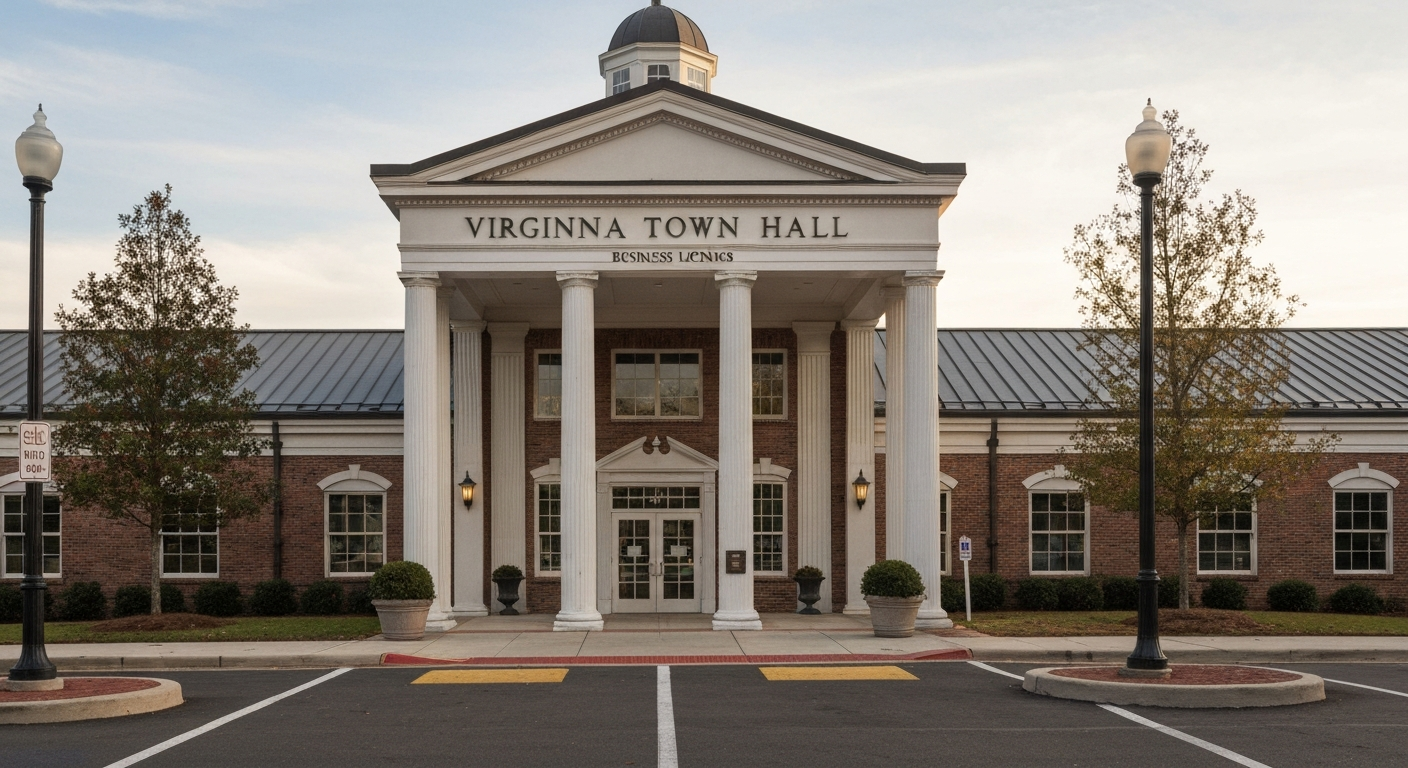
How to Get a Business License in Virginia (2026): Costs, Requirements & Where to Apply

Most people starting a business in Virginia search for “how to get a Virginia business license” — and then spend 20 minutes clicking through state websites wondering why they can’t find one. Here’s why: Virginia doesn’t issue a general state business license. There isn’t one.
Business licensing in Virginia is handled at the local level, meaning your city or county. Every jurisdiction has its own process, its own office, and its own fee structure. If you’re in Richmond, you file in Richmond. Virginia Beach? File there. An online business operating out of your home in Fairfax County? Still Fairfax County.
On top of local licensing, some professions — contractors, real estate agents, cosmetologists, healthcare providers — need additional state-level licensing through a separate agency entirely.
This guide explains how the system works and tells you exactly where to go based on where you’re located.
How Virginia Business Licensing Actually Works
Virginia is one of the few states that doesn’t have a general state business license. Most states have at least a basic registration or license at the state level — Virginia largely leaves that function to its 95 counties and 38 independent cities.
Each locality issues its own business license. The rules, fees, and application processes vary — sometimes significantly — from one jurisdiction to the next.
BPOL tax — short for Business, Professional and Occupational License tax — is the mechanism most Virginia localities use. It’s both a license and a tax rolled into one. When you apply for a business license in most Virginia cities and counties, you’re really applying for a BPOL license. You pay a fee based on your gross receipts category, not a flat rate.
Your primary contact for all of this is your local Commissioner of the Revenue — the elected official responsible for business licensing and tax assessment in most Virginia cities. Some counties use a Director of Finance instead. Either way, this is the office that processes your application, assigns your BPOL category, and collects your annual fee.
One important nuance: if your business operates in multiple Virginia localities — say, you have a warehouse in Henrico County and a retail storefront in Richmond — you may need a license in each jurisdiction where you have a physical presence or conduct significant operations. Check with each locality individually.
How to Get a Local Business License in Virginia
The process is more consistent across localities than you might expect, even though the specifics vary.
Step 1: Identify Your Locality
Virginia has 95 counties and 38 independent cities — and they’re genuinely independent, meaning a city isn’t part of the surrounding county. Richmond is not in Henrico County. Alexandria is not in Fairfax County. This matters because it determines exactly which office you file with.
If you’re not sure which jurisdiction applies to your business address, the Virginia SCC’s business search can help confirm your registered address. For your physical operating location, use your mailing address to identify the city or county.
Step 2: Contact Your Commissioner of the Revenue
Once you know your locality, find the Commissioner of the Revenue (or equivalent office). A list of the largest cities is in the next section. For smaller localities, search “[your city/county] Virginia Commissioner of the Revenue” — every jurisdiction has an office and most have a website with instructions.
Call or visit their site before applying. Requirements differ, and some localities have added online portals in recent years while others still prefer in-person filings.
Step 3: Determine Your BPOL Category
Your BPOL tax rate depends on your type of business. The major categories are typically:
| Business Category | Typical Rate (per $100 gross receipts) |
|---|---|
| Retail | $0.20 |
| Professional services | $0.58 |
| Contractors | $0.16 |
| Repair services | $0.36 |
| Financial services | $0.58 |
| Wholesale | $0.05–$0.22 |
Rates vary by locality — these are representative figures, not universal rates.
The Commissioner of the Revenue will assign your category based on your primary business activity. If your business spans multiple categories, you may have to allocate your gross receipts across them.
Step 4: Apply and Pay
Most localities let you apply online, by mail, or in person. You’ll typically need:
- Your business name (and LLC/corporation name if applicable)
- Business address
- EIN (Employer Identification Number) or Social Security Number
- Description of your business activity
- Estimated gross receipts for the first year
New businesses often pay a flat fee or estimated amount in year one, then true up the following year based on actual gross receipts. Annual renewal is required — typically due by March 1st, though deadlines vary by locality.
Timeline: Most localities process business license applications the same day or within a few business days. It’s rarely a bottleneck.
Business License Contacts for Virginia’s Largest Cities
| City | Office | Phone | Website |
|---|---|---|---|
| Richmond | Commissioner of the Revenue | (804) 646-7000 | richmondgov.com |
| Virginia Beach | Commissioner of the Revenue | (757) 385-4456 | vbgov.com |
| Norfolk | Commissioner of the Revenue | (757) 664-7000 | norfolk.gov |
| Arlington County | Commissioner of the Revenue | (703) 228-3060 | arlingtonva.us |
| Alexandria | Business Tax & Licensing | (703) 746-3940 | alexandriava.gov |
| Chesapeake | Commissioner of the Revenue | (757) 382-6738 | cityofchesapeake.net |
| Newport News | Commissioner of the Revenue | (757) 926-8657 | nnva.gov |
| Hampton | Commissioner of the Revenue | (757) 727-6700 | hampton.gov |
| Roanoke | Commissioner of the Revenue | (540) 853-2521 | roanokeva.gov |
| Lynchburg | Commissioner of the Revenue | (434) 856-2489 | lynchburgva.gov |
If your locality isn’t listed: Search “[your city or county] Virginia Commissioner of the Revenue” — every jurisdiction has an office. For counties that don’t use a Commissioner of the Revenue structure, search “[county name] Virginia business license” to find the equivalent.
State Professional Licenses (DPOR and Other Agencies)
Local licensing covers most businesses. But if you work in a regulated profession, you need additional state-level licensing on top of your local BPOL license — not instead of it.
The Department of Professional and Occupational Regulation (DPOR) handles licensing for dozens of professions in Virginia. Common examples include:
- General contractors and subcontractors (electricians, plumbers, HVAC)
- Real estate agents and brokers
- Barbers and cosmetologists
- Home inspectors
- Asbestos and lead abatement workers
- Landscape architects
- Soil scientists
If your profession appears on this list, you’ll need to apply through dpor.virginia.gov. Fees vary by license type and profession — expect anywhere from $50 to several hundred dollars depending on what you’re applying for. Many licenses also require proof of education, experience hours, or passing an exam.
Other state agencies cover additional regulated industries:
- Healthcare providers (physicians, nurses, dentists, therapists): Virginia Department of Health Professions
- Food service businesses (restaurants, food trucks, catering): Virginia Department of Health
- Alcohol beverage sales: Virginia Alcoholic Beverage Control Authority (ABC)
- Insurance agents and brokers: Virginia Bureau of Insurance
The licensing process and timeline for each agency varies. If your business touches any of these areas, check the relevant agency’s website early — some approvals take weeks or months, and you can’t legally operate without them.
How Much Does a Virginia Business License Cost?
There’s no single answer, but here’s a realistic range for planning purposes.
BPOL tax is calculated as a rate per $100 of gross receipts. That rate depends on your business category and your specific locality. At the low end, wholesale businesses might pay $0.05 per $100. Professional services typically pay closer to $0.58 per $100. Retail sits somewhere in the middle.
Most localities also have a minimum tax — usually $30–$50 — which you pay regardless of how little revenue you generated. If your gross receipts are below a certain threshold (often $100,000–$200,000, depending on the locality), you may qualify for a reduced rate or flat fee.
Some very small businesses fall below the minimum threshold and are effectively exempt from BPOL tax in their locality. Check with your Commissioner of the Revenue — don’t assume you’re exempt, but don’t assume you owe the full rate either.
New businesses often pay a flat fee or an estimate in year one rather than a receipts-based calculation, since you don’t have prior-year revenue to report. Some localities charge a flat $30–$100 for your first year.
Rough budget for a new small business: $50–$200 for your first year is a reasonable estimate if you’re just getting started and your gross receipts are modest. If you’re a professional service firm (lawyer, consultant, accountant) billing significant revenue from day one, budget higher — the $0.58 per $100 rate adds up.
These figures are for local BPOL licensing only. State professional licenses (DPOR, etc.) add separate fees on top of this.
Frequently Asked Questions
Is there a Virginia state business license?
No. Virginia doesn’t issue a general state business license. Licensing is handled at the local level by your city or county — specifically through the Commissioner of the Revenue or equivalent office. If you’re searching the Virginia SCC’s website for a business license and can’t find one, that’s why.
Do I need a business license if I work from home?
Usually yes. Most Virginia localities require a business license for any business operating within their jurisdiction, including home-based businesses. Your physical address determines which locality’s rules apply.
There’s a second layer too: home-based businesses often need a home occupation permit from the local zoning office, separate from the business license. This permit confirms that your business activity is allowed in a residential zone. Contact your local zoning department to check — requirements vary, but running a business with employee foot traffic or commercial deliveries from a residential address often triggers zoning review.
Do I need a business license for an online business?
If your business is based in Virginia — meaning you operate from a Virginia address — your local jurisdiction very likely requires a BPOL license even if all your sales happen online and your customers are elsewhere. The license is tied to where you operate, not where your customers are.
Contact your Commissioner of the Revenue and describe your business. They’ll tell you whether you’re required to file and which category you fall under.
What happens if I operate without a business license?
Penalties vary by locality, but the consequences are real. Most jurisdictions will charge back taxes for any unlicensed period once they discover the oversight. Many add penalties and interest on top of that. In some Virginia localities, operating without a required business license is a Class 1 misdemeanor — the same category as reckless driving.
It’s also worth noting that operating without proper licensing can affect your ability to enforce contracts, collect payments in disputes, and maintain your business entity’s liability protection. Don’t skip this step.
Does forming an LLC or corporation replace the need for a business license?
No. Forming an LLC or corporation with the Virginia State Corporation Commission (SCC) registers your business entity with the state. It has nothing to do with local business licensing. An LLC formation and a BPOL license are entirely separate requirements from different government offices. You need both.
What to Do Next
-
Confirm your locality. Your business address determines whether you file with a city or a county — and they’re separate in Virginia.
-
Find your Commissioner of the Revenue. Use the table above for Virginia’s largest cities, or search “[your locality] Virginia Commissioner of the Revenue” for everyone else.
-
Ask about your BPOL category. When you contact the office, describe your primary business activity and ask which rate category applies to you.
-
Check DPOR if you’re in a regulated profession. Review the DPOR license lookup to see whether your profession requires state licensing. Apply for that license before you start operating — some take time to process.
-
Apply and renew annually. Most localities process applications quickly. Set a reminder for your renewal deadline — typically March 1st, but confirm with your locality.
Virginia’s licensing system is fragmented by design. There’s no state portal that handles everything in one place, and no single checklist that applies to every business. But once you understand that local = BPOL and some professions = DPOR on top of that, the path forward is clear.
This article provides general informational guidance and does not constitute legal or tax advice. Requirements vary by locality and profession. Consult with a licensed attorney or CPA for advice specific to your situation.